ASPIRE & Dr. Maeve O’Connor – Changing Views on IVIG at the AAP
Wendy Nawara, MSW, ASPIRE Past President & Founding Board Member, interviews Maeve E. O’Connor, MD FACAAI FAAAAI FACP on the Changing Views at AAP on IVIG PANS/PANDAS. Full video...
“I was so shocked I just took the picture because I didn’t even believe what I was seeing,” she said of a photo she snapped that went viral on social media. “It’s not an appropriate place...
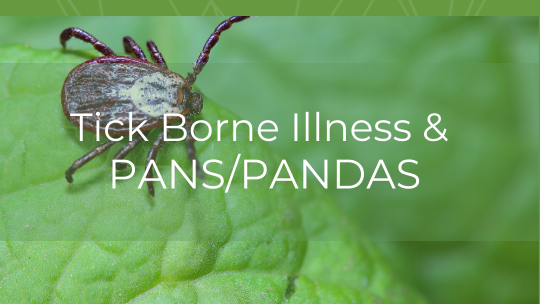
Polymicrobial nature of tick-borne diseases 430 of 678 (63%) positive for at least one human pathogen 57% Adults/27% Nymphs – Lyme 14% Adults/15% Nymphs -Babesia 14% Adults/2% Nymphs –...
Ajmone-Cat MA, Spinello C, Valenti D, Franchi F, Macrì S, Vacca RA, Laviola G. Journal of Clinical Medicine. 2019; 8(10):1514. DOI: 10.3390/jcm8101514
ANS PANDAS impacts the physical health of a student and causes psychological, neurological, behavioral, and developmental difficulties. Learn more about PANS PANDAS at...
If uncontrollable thoughts, fears, and other behavioral changes are taking over your child’s life, Learn About PANS...
Platt, Maryann P.
Columbia Academic Commons-2019 Theses Doctoral
Taken together, these data demonstrate the pivotal role of Th17 lymphocytes in brain pathology and olfactory processing deficits after recurrent GAS infections in our mouse model. Our intranasal inoculation model supports the conclusion that post-infectious BGE is autoimmune in nature, despite the absence of behavioral symptoms in this model. Using multiple mouse models of post-infectious BGE may allow us to study distinct facets of disease pathogenesis. Finally, this work underscores the ability of T cells to incite neuroinflammation, provides a useful clinical diagnostic test in olfactory functional assessments, and lends support to T cell immunotherapy strategies in patients with post-infectious BGEs.
Madeleine W. Cunningham
Microbiology Spectrum-August 2019
Author manuscript – In advance of print
The studies suggest 1) that the antibodies against streptococci and brain in Sydenham chorea and related diseases produce CNS dysfunction through a neuronal signal transduction and subsequent excess dopamine release mechanism and 2) that the molecular targets of the chorea antibodies include lysoganglioside and the dopamine receptors in neuronal cell membranes. The anti-neuronal autoantibodies also target the group A streptococcal carbohydrate epitope N-acetyl beta-D-glucosamine present on the rhamnose backbone of the carbohydrate and present in the cell membrane and wall of the group A streptococci as well as the intracellular brain protein tubulin. The diagram in Figure 15 illustrates proposed events of how antineuronal autoantibodies against lysoganglioside and the dopamine receptors D1 and D2 may function in Sydenham chorea and PANDAS (3).
PANDAS Physicians Network An Overview for Diagnosing and Treating PANS/PANDAS Susan E. Swedo, MD – Scientist Emeritus at the National Institute of Health Complete CME Webinar: Online PANS...
Mona Gerentes, Antoine Pelissolo, Krishnamoorthy Rajagopal, Ryad Tamouza, Nora Hamdani,
Anxiety Disorders-August 2019
This review highlights that OCD is associated with low-grade inflammation, neural antibodies, and neuro-inflammatory and auto-immune disorders. In some subset of OCD patients, autoimmunity is likely triggered by specific bacterial, viral, or parasitic agents with overlapping surface epitopes in CNS. Hence, subset-profiling in OCD is warranted to benefit from distinct immune-targeted treatment modalities.