Legislative Takeaway
- The OHIC report was required to answer a narrow statutory question about short-term insurer savings, not whether PANS/PANDAS coverage is medically necessary or beneficial to families.
- The report does not find insurer savings, but it also finds that mandated coverage has only a minimal impact on premiums, consistently measured in pennies or fractions of pennies per member per month.
- Claims data is inherently unreliable due to the lack of specific diagnostic codes, making it difficult to draw firm conclusions about utilization or cost trends.
- The analysis does not evaluate the cost of delayed or denied care, including psychiatric hospitalizations, school disruption, long-term disability, or family financial strain.
- Repealing the mandate would not meaningfully reduce premiums, but would likely reintroduce coverage denials, delayed treatment, and inequitable access, particularly for families unable to pay out of pocket.
Policy implication: The report supports maintaining mandated PANS/PANDAS coverage as a low-cost, access-protecting benefit rather than rolling it back based on an analysis that was never designed to measure the full cost of the condition.
Download Materials
- Rhode Island Office of the Health Insurance Commissioner’s cost-benefit analysis of PANS/PANDAS treatment coverage.
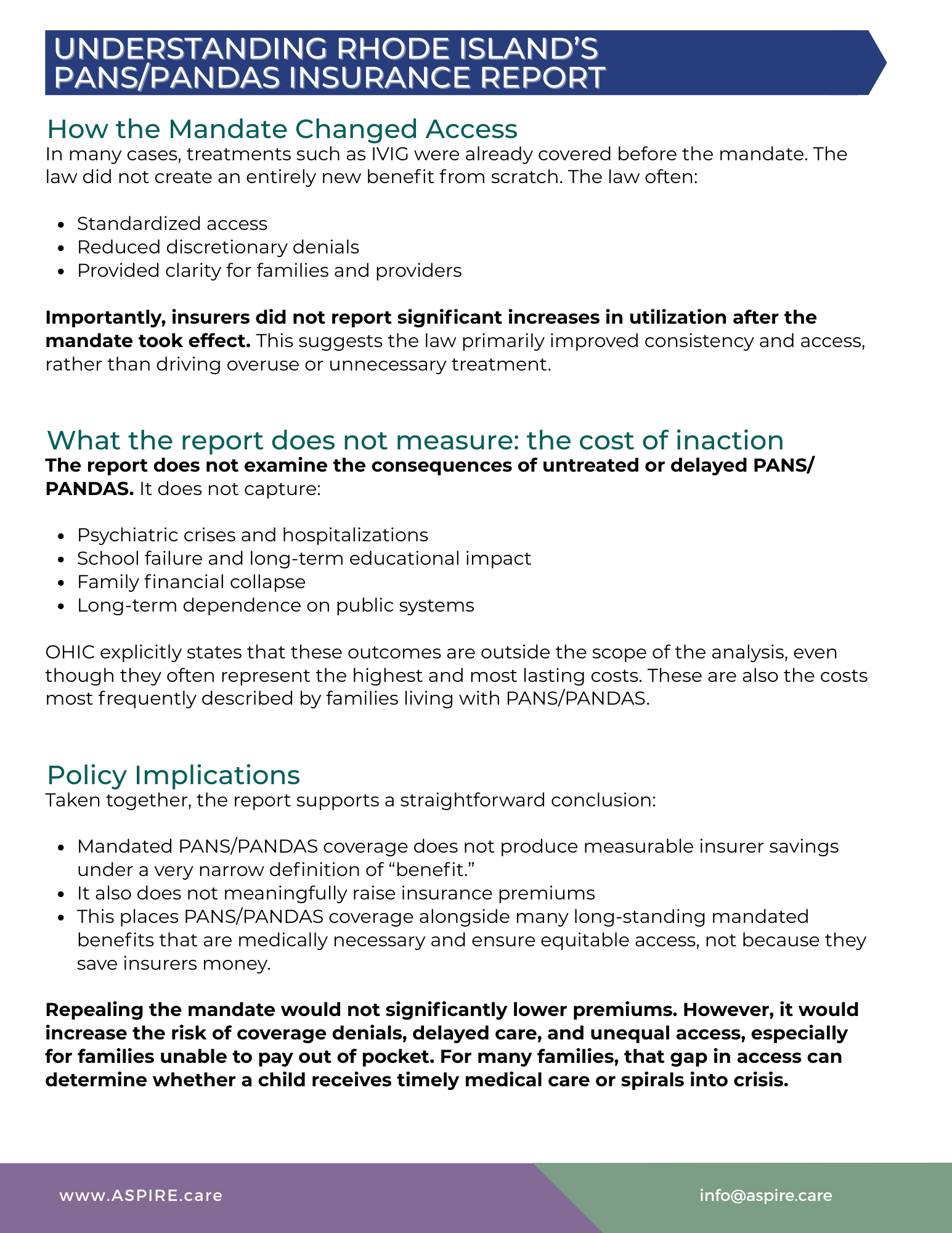
- ASPIRE’s Explainer on RI PANS PANDAS Insurance Report
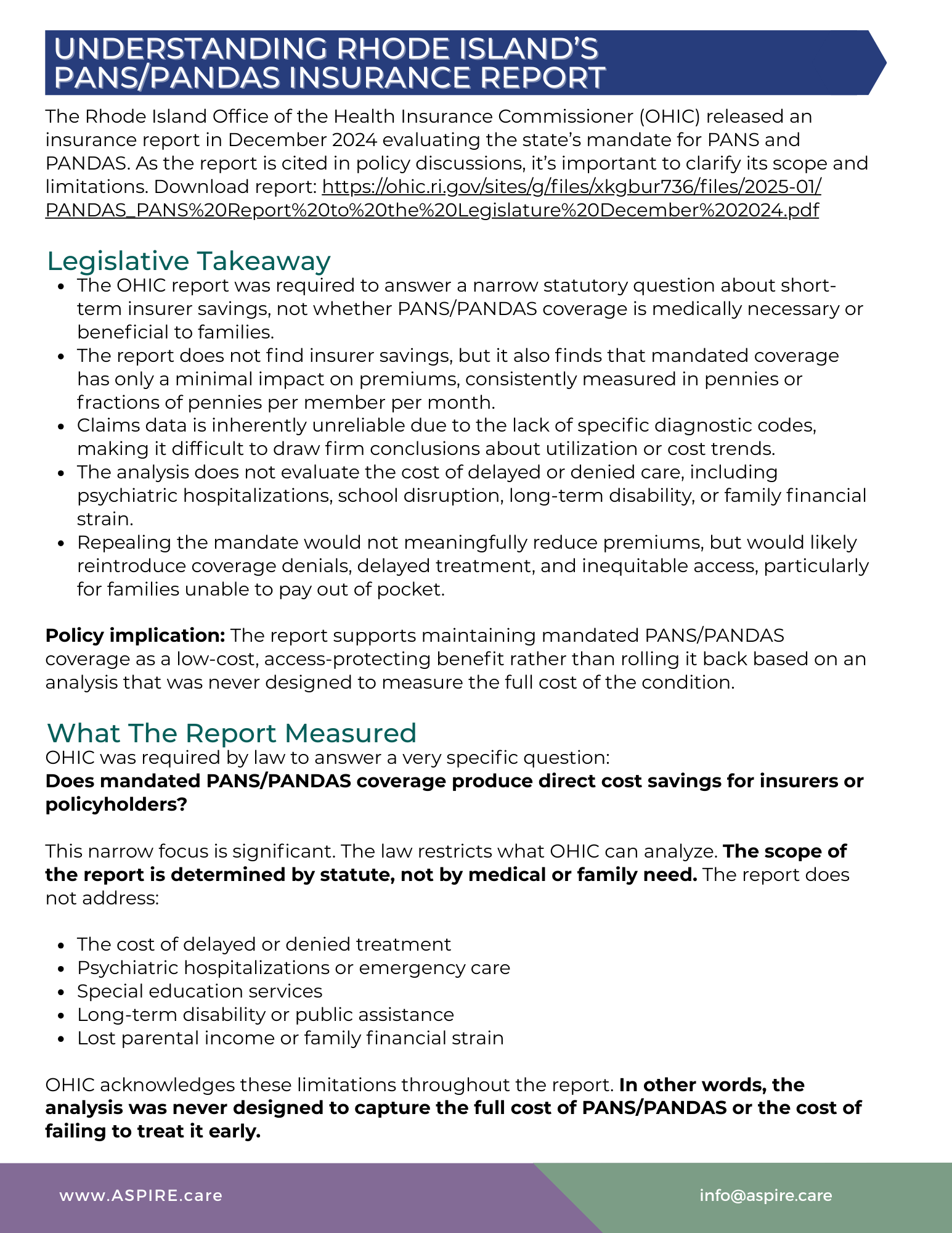
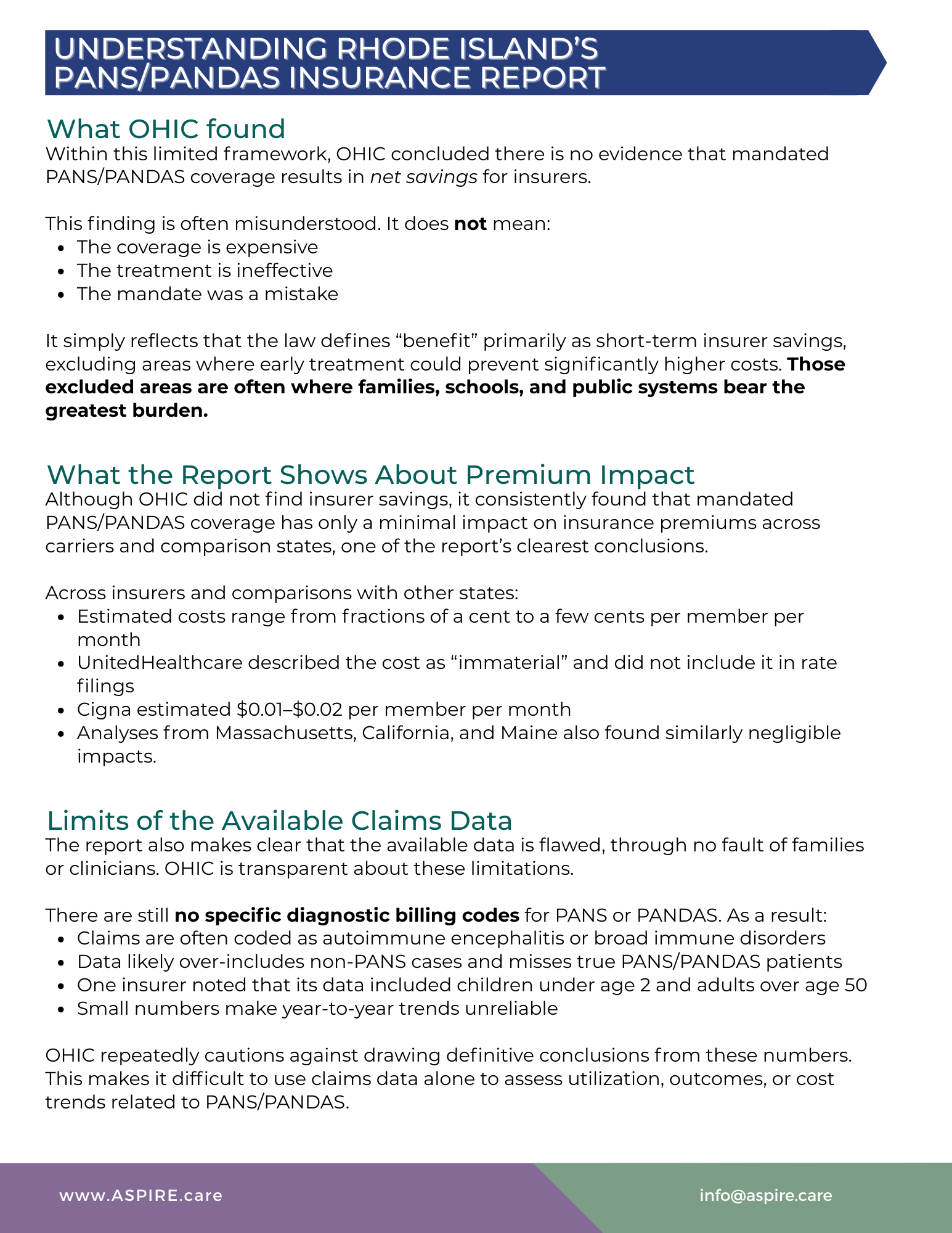
In December 2024, the Rhode Island Office of the Health Insurance Commissioner (OHIC) released a report evaluating the state’s insurance mandate for PANS and PANDAS. As this report is cited in policy discussions, it is important to clarify its scope and limitations.
What The Report Measured
OHIC was required by law to answer a very specific question:
Does mandated PANS/PANDAS coverage produce direct cost savings for insurers or policyholders?
Does mandated PANS/PANDAS coverage produce direct cost savings for insurers or policyholders?
This narrow focus is significant. The law restricts what OHIC can analyze. The scope of the report is determined by statute, not by medical or family need. The report does not address:
- The cost of delayed or denied treatment
- Psychiatric hospitalizations or emergency care
- Special education services
- Long-term disability or public assistance
- Lost parental income or family financial strain
OHIC acknowledges these limitations throughout the report. In other words, the analysis was never designed to capture the full cost of PANS/PANDAS or the cost of failing to treat it early.
What OHIC found
Within this limited framework, OHIC concluded there is no evidence that mandated PANS/PANDAS coverage results in net savings for insurers.
This finding is often misunderstood. It does not mean:
- The coverage is expensive
- The treatment is ineffective
- The mandate was a mistake
It simply reflects that the law defines “benefit” primarily as short-term insurer savings, excluding areas where early treatment could prevent significantly higher costs. Those excluded areas are often where families, schools, and public systems bear the greatest burden.
What the Report Shows About Premium Impact
Although OHIC did not find insurer savings, it consistently found that mandated PANS/PANDAS coverage has only a minimal impact on insurance premiums across carriers and comparison states, one of the report’s clearest conclusions.
Across insurers and comparisons with other states:
- Estimated costs range from fractions of a cent to a few cents per member per month
- UnitedHealthcare described the cost as “immaterial” and did not include it in rate filings
- Cigna estimated $0.01–$0.02 per member per month
- Analyses from Massachusetts, California, and Maine also found similarly negligible impacts.
Limits of the Available Claims Data
The report also makes clear that the available data is flawed, through no fault of families or clinicians. OHIC is transparent about these limitations.
There are still no specific diagnostic billing codes for PANS or PANDAS. As a result:
- Claims are often coded as autoimmune encephalitis or broad immune disorders
- Data likely over-includes non-PANS cases and misses true PANS/PANDAS patients
- One insurer noted that its data included children under age 2 and adults over age 50
- Small numbers make year-to-year trends unreliable
OHIC repeatedly cautions against drawing definitive conclusions from these numbers. This makes it difficult to use claims data alone to assess utilization, outcomes, or cost trends related to PANS/PANDAS.
How the Mandate Changed Access
In many cases, treatments such as IVIG were already covered before the mandate. The law did not create an entirely new benefit from scratch. The law often:
- Standardized access
- Reduced discretionary denials
- Provided clarity for families and providers
Importantly, insurers did not report significant increases in utilization after the mandate took effect. This suggests the law primarily improved consistency and access, rather than driving overuse or unnecessary treatment.
What the report does not measure: the cost of inaction
The report does not examine the consequences of untreated or delayed PANS/PANDAS. It does not capture:
- Psychiatric crises and hospitalizations
- School failure and long-term educational impact
- Family financial collapse
- Long-term dependence on public systems
OHIC explicitly states that these outcomes are outside the scope of the analysis, even though they often represent the highest and most lasting costs. These are also the costs most frequently described by families living with PANS/PANDAS.
The bottom line
Taken together, the report supports a straightforward conclusion:
- Mandated PANS/PANDAS coverage does not produce measurable insurer savings under a very narrow definition of “benefit.”
- It also does not meaningfully raise insurance premiums
- This places PANS/PANDAS coverage alongside many long-standing mandated benefits that are medically necessary and ensure equitable access, not because they save insurers money.
Repealing the mandate would not significantly lower premiums. However, it would increase the risk of coverage denials, delayed care, and unequal access, especially for families unable to pay out of pocket. For many families, that gap in access can determine whether a child receives timely medical care or spirals into crisis.
Gabriella True
