PANS PANDAS is a medical condition in which symptoms affect a student’s ability to attend school and learn.
School Impact
PANS PANDAS not only impacts the physical health of a student but also causes psychological, neurological, behavioral, and developmental difficulties.
Symptomology and symptom severity vary from student to student and even from flare to flare in the same student. The goal of treatment is to achieve full recovery in order to prevent the student’s condition from becoming a chronic, debilitating illness. Treatment includes medical protocols as well as therapeutic practices. School accommodations are an essential component of a thorough and appropriate treatment protocol. Please read the overview of PANS in the school setting below and then follow up with ASPIRE’s Resources for Schools & Educators. Please register for a virtual in-services on PANS PANDAS.
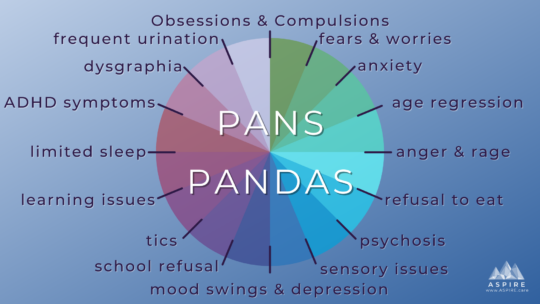
PANS PANDAS Symptoms Seen at School at a Glance
- OCD
- Restricted Eating
- School Related Anxiety
- Separation Anxiety
- School Refusal
- Vocal and motor tics
- Behavioral Regression
- Urinary Frequency
- Behavioral Changes: Increased oppositional defiance, rage, emotional lability, depression
- Academic Regression: decline in handwriting, arithmetic, reading skills
- Executive Planning Issues
- Processing Delays
- Sensory Issues
- Impulsivity, Inattention, Limited Concentration
- Decreased physical & mental
Individualized and Flexible Plans
Most PANS PANDAS students require individualized school accommodations to some degree, ranging from an Individualized Education Plan (IEP) to a 504 plan, to an Individualized Health Care Plan (ICHP) to non-formalized supports built into classroom friendly strategies.
The accommodations vary depending on the student’s symptoms and severity as well as from flare to flare. Each symptom can cause its own set of difficulties at school and when combined with several symptoms, even more significant challenges must be addressed. There is neither a one size fits all presentation of symptoms nor a one size fits all set of accommodations.
Due to the changing nature of symptoms and the relapsing and remitting course of PANS, ensure plans are flexible. Plans should be written with the student’s worst days in mind while hoping for the best days. A student may initially present with one or more primary symptoms, which may resolve with treatment only to be replaced with a new set of symptoms or different manifestations of the initial symptoms. Academic performance and attendance can vary widely during exacerbations.
One month, a student may be in a debilitating flare requiring several supports but later in the school year require significantly less only to relapse again. Not all PANS students return to baseline between flares, requiring year-round accommodations even while not in an active flare. Student performance and needs can vary day-to-day and week-to-week.
Other Health Impairment (OHI) is the condition that most PANS students qualify for an IEP. Students may be eligible for an IEP under different categories as well depending on that student’s symptoms such as specific learning disability (SLD), autism spectrum disorder (ASD) or emotional and behavioral disorder (EBD). However, caution must be taken to not mislabel a student; SLD or EBD may not encompass all of the student’s issues by focusing too much on a small portion of symptoms.
Read more about OHI for PANS/PANDAS.
“Writing the plans with the most difficult days in mind will assure that the child can receive adequate accommodations without revisiting the 504 or IEP process often.”
Clinical Management of Pediatric Acute-Onset-Neuropsychiatric Syndrome: Part I–Psychiatric and Behavioral Interventions, Margo Thienemann, MD et alKey Take Away Points
- Kids can get better
- PANS/PANDAS is medical
- PANS affects multiple domains of learning
- Don’t blame the child for his/her illness
- PANS is essentially a spectrum disorder
- All treatments and accommodations must be individualized
- Symptoms are relapsing and remitting
- The whole team must communicate and collaborate
- Schools need to provide fluid access in and out of service
- Plan for the worst and hope for the best
Resources for Schools & Educators on PANS PANDAS
Why Other Health Impairment (OHI) is the Appropriate IEP eligibility category for PANS/PANDAS
PANS/PANDAS Meets IDEA’s Definition of Other Health Impairment Students with PANS/PANDAS may experience sudden and severe symptoms that significantly disrupt school functioning across academic,...
Share Your College Experience with PANS/PANDAS
College with PANS/PANDAS: Your Story Matters Starting college can be challenging for any young adult. For students living with PANS/PANDAS, the transition often comes with added layers—managing...
Navigating College Accommodations for Students with PANS/PANDAS
Starting college is an exciting milestone, but for students with PANS/PANDAS, the transition can feel especially overwhelming. Balancing academics, health needs, and independence requires careful...
About PANS PANDAS from ASPIRE Video
Learn more about PANS PANDAS PANS PANDAS are misdirected immune responses that result in acute onset of OCD, tics, and/or restricted food intake, along with two neuropsychiatric symptoms in seven...
School In-Service Lectures at ASPIRE
Students with PANS/PANDAS have complex cognitive, behavioral, physical & neurological symptoms that affect their school performance. The school's multidisciplinary team benefits from an awareness of...
Accommodations and Educational Supports for PANS PANDAS by Nancy O’Hara, MD
Supporting Students with PANS, PANDAS, and Basal Ganglia Encephalitis: Children with PANS, PANDAS, and basal ganglia encephalitis often require specific school accommodations to support their...
Homeschooling and PANS/PANDAS: Resources for Families
Homeschooling and PANS/PANDAS: Resources for Families Traditional school environments can be challenging for many families navigating PANS/PANDAS. Symptoms such as anxiety, OCD, cognitive...
NJSSNA Spring 2025 Conference Pearls of Wisdom for School Nurses
ASPIRE to Speak at NJSSNA Spring 2025 Conference – Pearls of Wisdom for School Nurses Conference Details Friday, March 28, 2025 at 6:00pm ET – Saturday, March 29,...
Working Memory Supports with for Students with PANS PANDAS
Strategies and Accommodations for Supporting Students with Working Memory Challenges Students with PANS/PANDAS often face working memory, focus, and processing challenges. These strategies and...
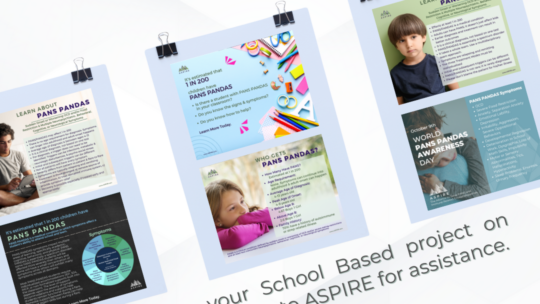
School Based Awareness Projects and Fundraisers
School Awareness Projects The key to a successful capstone project and/or awareness event is to be passionate and committed to the cause. Raising awareness about PANS and PANDAS can...
Massachusetts School Nurse Program on PANS/PANDAS
Presentation Details PANS/PANDAS Symptoms and Solutions in the School Setting: An Overview for the School Nurse Presenter: Gabriella True, ASPIRE President Addendum Topic: Massachusetts...