When the People You Love Don’t Believe PANS Is Real
A letter families often wish they didn’t have to write
If you’re reading this, you probably care about our family and our child. We understand that what we’re going through may seem confusing, unfamiliar, or even hard to believe. Sudden and extreme changes in behavior don’t match how most people think about illness, especially when the symptoms seem psychiatric.
PANS is still not widely covered in medical training, and many doctors and families haven’t yet learned about the science. This gap in education is real.
But what we are living with is also real.
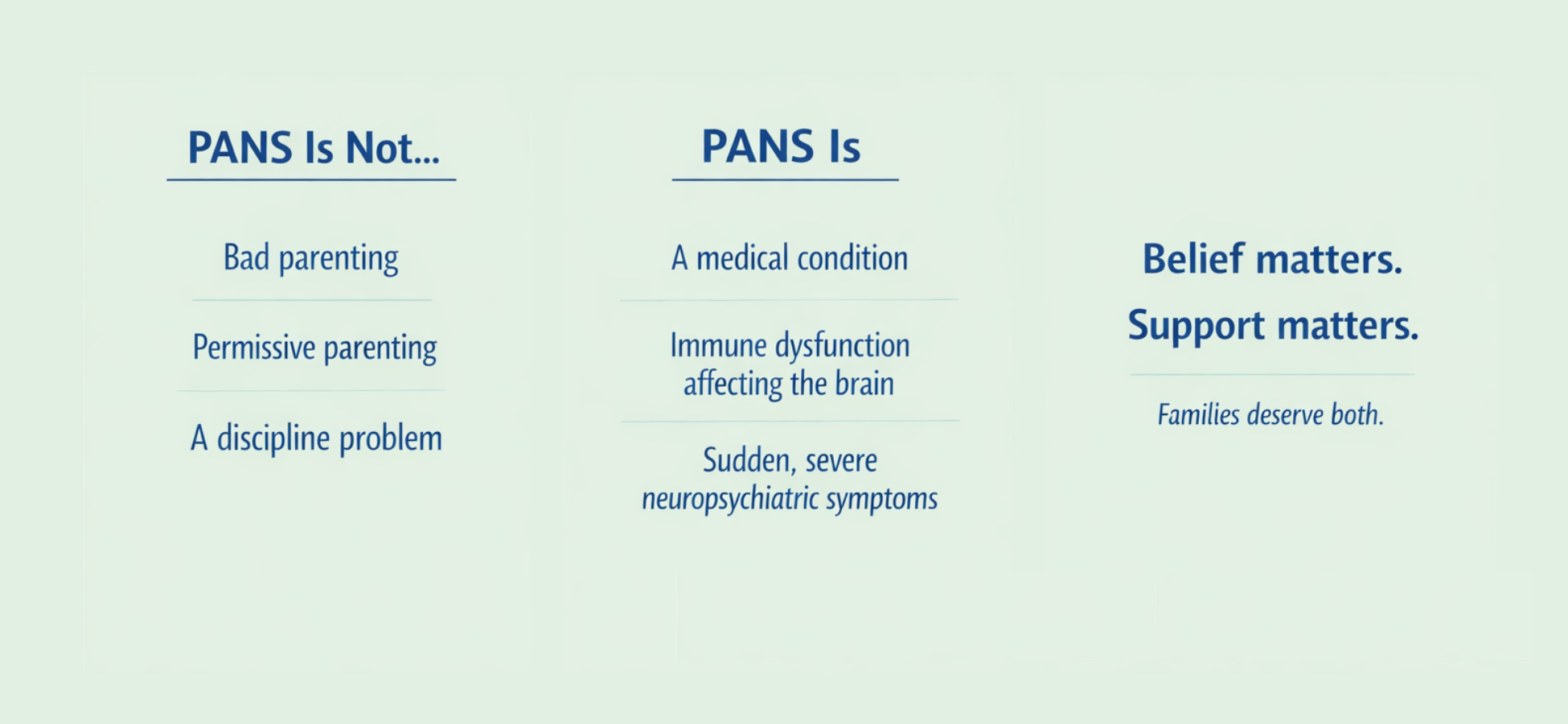
Pediatric Acute-Onset Neuropsychiatric Syndrome (PANS) is a medical condition where problems with the immune system affect the brain, causing severe symptoms to appear suddenly, sometimes overnight. These symptoms can include obsessive-compulsive behaviors, intense anxiety, food restriction, changes in thinking, emotional ups and downs, sensory sensitivities, trouble sleeping, and physical issues. This is not caused by stress. It is not a discipline problem. And it is not something a child can “push through.”
We also want to be clear about something that many families hear, whether directly or indirectly:
This is not bad parenting.
This is not permissive parenting.
This is not a lack of boundaries or structure.
PANS temporarily disrupts the brain circuits that help with self-control, flexibility, and sensing danger. Skills that used to be strong can suddenly disappear. The behaviors that follow are symptoms, not choices. Parenting strategies that work for most children often don’t help here, not because parents aren’t trying, but because the brain systems those strategies depend on are affected during illness flares.
Many families spend months or years being urged to “parent harder,” stop accommodating, or enforce consequences, only to watch their child worsen. That experience is not theoretical. It is widely shared among families affected by PANS.
Part of the confusion comes from the fact that PANS is an emerging medical disorder. It’s not new, but understanding, research, and teaching about it are still developing. Science takes time. Research can take years to complete, even longer to replicate, and even longer to become part of medical training. Medical schools often take a while to catch up, especially with new fields that combine immunology, neurology, psychiatry, and pediatrics.
This is one reason PANS is not regularly taught in medical schools or residency programs. Many doctors simply were never trained on it. The lack of exposure does not mean the condition isn’t real; it just means the system has not caught up yet.
Despite that lag, recognition is growing.
More than 20 U.S. states have passed or implemented mandated insurance coverage for PANS- or PANDAS-related care. Major insurers, including Aetna, now recognize PANS/PANDAS as serious, immune-mediated conditions and cover treatment when medical criteria are met. These decisions are not made lightly. They reflect accumulating clinical experience, peer-reviewed research, and real-life outcomes.
Another misconception we often encounter is that PANS is limited to childhood or that it resolves cleanly with age.
There is no age limit on PANS.
Symptoms can persist into adolescence and adulthood, and adult-onset PANS does occur. What is most important is how quickly the illness is recognized and whether appropriate care is obtainable. Earlier recognition and getting appropriate treatment are associated with better outcomes, but recovery is rarely simple.
Healing is not linear. Many people experience a sawtooth pattern, meaning improvement followed by setbacks. PANS also has a relapsing and remitting disease course. Someone may appear stable for a period of time and then suddenly get worse, they have a flare, after a new trigger, such as another infection. From the outside, this can look inconsistent or confusing. From the inside, it is exhausting and frightening.
We are not asking you to become an expert.
We are not asking you to agree with every medical decision.
We are asking for something simpler and more human.
Please believe that:
- We did not choose this.
- Our loved one did not choose this.
- Minimizing or moralizing symptoms does not make them disappear.
- Support, curiosity, and compassion matter more than certainty.
Supporting someone with PANS does not require you to fully understand everything. It means staying open, avoiding judgment or simplifying too much, and realizing that families are often dealing with medical uncertainty, financial stress, changes to school or work, and deep emotional exhaustion all at the same time.
PANS affects entire families. Healing is better supported when relatives and friends are willing to listen, learn, and stand alongside us, even when the illness doesn’t behave as people expect.
Even if you’re unsure what you believe about PANS, you can still believe us.
Right now, your belief matters more than you might realize.
Gabriella True

One comment to When the People You Love Don’t Believe PANS Is Real
Deb Pettirossi
March 19, 2026Great article Gabrielle! This is so important for families dealing with PANS. We really need the support and understanding of friends and family and not judgement.