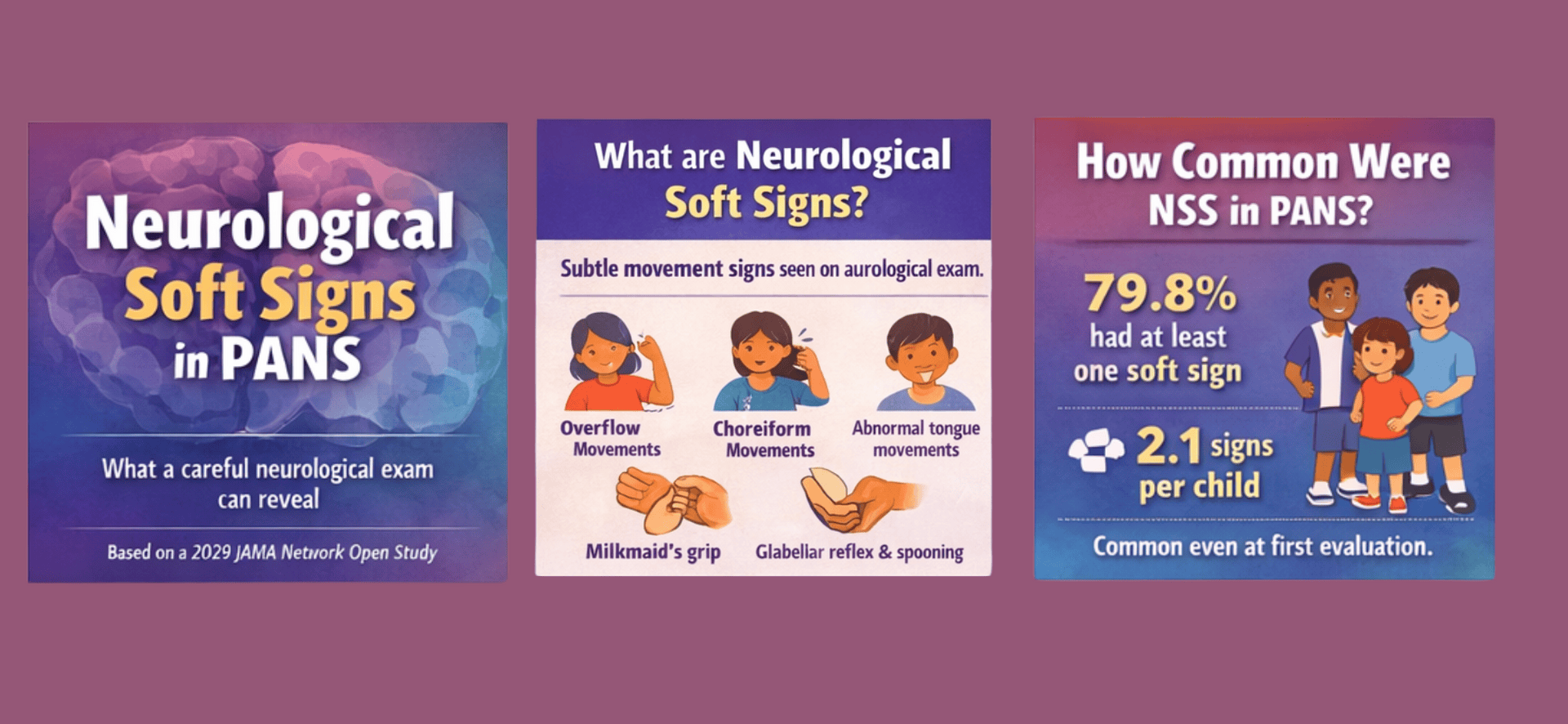
Zebrack JE, Gao J, Verhey B, Tian L, Stave C, Farhadian B, Ma M, Silverman M, Xie Y, Tran P, Thienemann M, Wilson JL, Frankovich J. Neurological Soft Signs at Presentation in Patients With Pediatric Acute-Onset Neuropsychiatric Syndrome. JAMA Network Open. 2025;8(3):e250314. doi:10.1001/jamanetworkopen.2025.0314
What Are Neurological Soft Signs (NSS)?
In this study, neurological soft signs (NSS) are defined as subtle neurological examination findings that may reflect dysfunction in motor coordination and movement regulation, particularly related to basal ganglia pathways — the brain circuits critical for motor control, behavior regulation, and habit learning.
The authors evaluated six specific NSSs that have been historically associated with basal ganglia involvement:
- Glabellar Tap Reflex – a repetitive blinking response to tapping between the eyebrows that normally fades quickly in healthy individuals.
- Abnormal Tongue Movements – such as worm-like motion or darting movements beyond normal control.
- Milkmaid’s Grip – difficulty maintaining a sustained grip, with squeezing force that waxes and wanes, reminiscent of milking motion.
- Choreiform Movements – brief, irregular, non-rhythmic movements of the limbs, finger, or body that resemble chorea.
- Spooning – an abnormal hand posture where fingers curve inward like a spoon.
- Overflow Movements – unintended movement of one body part when a different movement is intentionally performed.
These signs are considered “soft” because they are not definitive neurologic deficits like paralysis or loss of sensation, but rather subclinical indicators of subtle motor system dysfunction that may hint at underlying basal ganglia pathology.
How Common Were These Signs in PANS Patients?
In the cohort of 119 new patients presenting with PANS at a specialty clinic:
- 79.8% (95 of 119) had at least one NSS.
- On average, patients exhibited 2.1 NSSs.
This suggests that most children with PANS show detectable motor pattern abnormalities on neurological exam, even when classic “hard” signs (like overt chorea or dystonia) aren’t present.
Which NSSs Were Most Frequent?
Among the six examined signs:
- Overflow movements were the most common, seen in 59.7% of patients.
- Choreiform movements occurred in 52.1%.
- Abnormal tongue movements were present in 31.1%.
- Milkmaid’s grip was noted in 30.2%.
- Glabellar tap reflex abnormalities occurred in 21.8%.
- Spooning was the least common, found in 17.6%.
These results reflect a distribution of subtle movement irregularities that collectively point toward basal ganglia motor circuit involvement, even when overt neurological diagnoses are not present.
What Does Having More NSSs Mean Clinically?
The researchers also looked at whether the number of NSSs correlated with disease severity:
Patients with four or more NSSs had:
- More PANS symptoms on average (15.1 vs 11.5).
- Worse global functioning scores (56.0 vs 40.6).
- Statistical modeling showed that each additional NSS was associated with a 5% increase in the number of PANS symptoms.
These findings suggest that NSSs are not arbitrary findings — their presence and number appear to reflect overall clinical severity and impairment in this group of patients.
Why This Matters
Unlike dramatic signs like tremor or paralysis, neurological soft signs are subtle and often missed in routine exams. In this study:
- They were common in children with PANS, even at first clinical presentation.
- Their prevalence was linked with symptom burden, suggesting they provide meaningful clinical data, not just incidental observations.
- They align with what is known about basal ganglia involvement in PANS, supporting the idea that PANS affects neurological circuits, not just psychiatric domains.
What the Study Itself Says About NSS Interpretation
The authors note that these signs have been described in conditions that may involve motor circuit dysfunction (like ADHD, OCD, autism, and Sydenham chorea), and that recognizing them could enhance diagnostic accuracy in PANS.
Moreover, the study authors suggest that targeted neurological examinations — intentionally looking for these soft signs — may be valuable in clinical practice for children presenting with abrupt neuropsychiatric symptoms.
Takeaway
Children with PANS frequently show multiple subtle neurological soft signs on exam — especially overflow and choreiform movements — and the larger the number of these signs, the greater the symptom burden and impairment, reinforcing the idea that PANS is tied to underlying neurological circuitry involvement rather than being purely “psychiatric.”
Gabriella True
