
Starting college is an exciting milestone, but for students with PANS/PANDAS, the transition can feel especially overwhelming. Balancing academics, health needs, and independence requires careful planning and support. The good news: colleges are legally required to provide reasonable accommodations under the Americans with Disabilities Act (ADA) and Section 504 of the Rehabilitation Act. With the right steps, students with PANS/PANDAS can thrive in college—academically, socially, and personally.
As both a higher education professional and the parent of a student with PANS, I’ve seen firsthand the difference that preparation and advocacy can make. Below, I walk through how to access accommodations, helpful supports for PANS/PANDAS students, housing considerations, and what families need to know about FERPA.
After you have finished reading the article, if you’re a young adult with PANS/PANDAS or a parent or caregiver of a young adult, we’d love for you to share your college story and help guide others through this journey. We’re taking the next step by turning lived experience into a resource for others by creating a new page to highlight real college experiences while living with PANS/PANDAS. Learn more about sharing your experience at College with PANS/PANDAS: Your Story Matters.
Registering with the Office of Disability/Accessibility Services
Every college has an office dedicated to disability support (often called Disability Services, Accessibility Services, or Student Access Center). This is your student’s entry point for accommodations.
What to do:
- Gather documentation: Most colleges require recent medical documentation from a licensed professional. This can include a doctor’s note, neuropsychological evaluation, or medical records outlining the diagnosis and functional limitations.
- Schedule an intake meeting: The student (not the parent) must meet with the office to discuss their needs. This is where self-advocacy begins.
- Request specific accommodations: Instead of asking for “help,” be ready to describe how PANS/PANDAS affects learning, focus, executive functioning, or daily living.

Requesting Accommodations for Students with PANS/PANDAS
Because symptoms vary, accommodations should be tailored. Common and effective supports include:
- Academic Accommodations
- Extended time on exams or assignments
- Reduced distraction testing environment
- Flexibility with attendance policies during flares
- Note-taking assistance or access to lecture recordings
- Priority registration for classes (to manage course load and time of day)
- Executive Function & Support Tools
- Access to organizational coaching or academic success programs
- Use of technology supports (speech-to-text, task management apps)
- Permission to record lectures for review
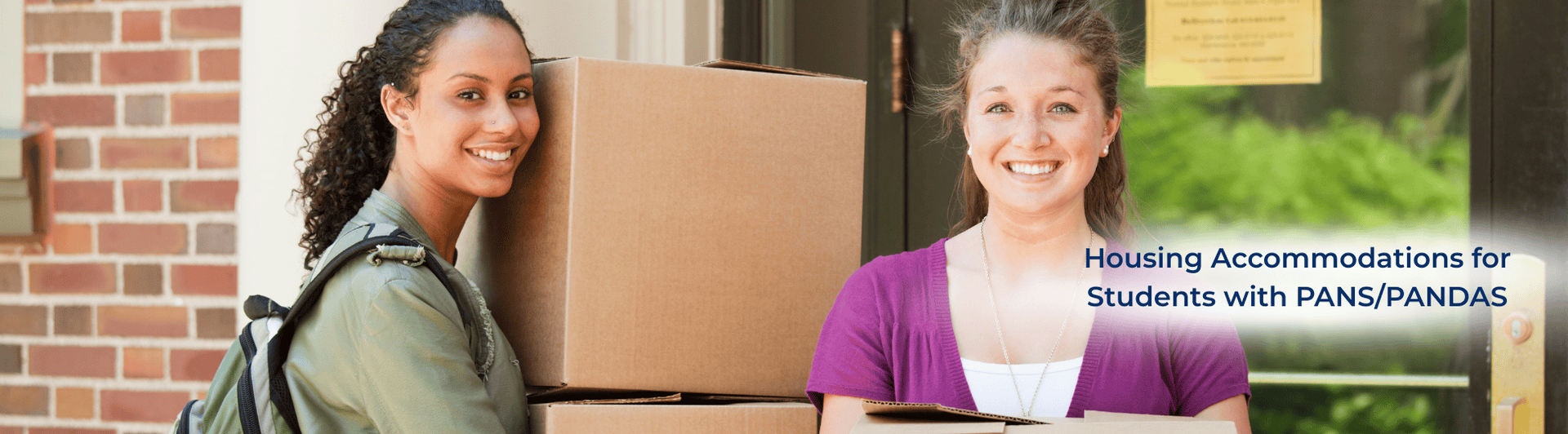
Housing Accommodations & Tips for Students with PANS/PANDAS
College housing is often overlooked, but for students with PANS/PANDAS, the right setup can make a huge difference.
- Request housing accommodations early: Housing requests usually have earlier deadlines than academic accommodations.
- Be specific: Instead of saying “quiet space,” have your doctor’s letter explain the medical reason—for example, “Due to neuroimmune symptoms, the student requires housing that minimizes disruption and supports consistent sleep.”
- Consider roommate options: While a single room may be appropriate in some cases, living with a roommate can also be beneficial. Sharing a space teaches compromise, fosters social skills, and opens students to new experiences—sometimes even new cultures. A balanced option could be requesting a double room instead of a triple, reducing disruptions while still offering the growth that comes with a roommate.
- Connect with Residence Life staff: Directors of Residence Life can be important allies.
- Plan for flexibility: If a flare makes living on campus too difficult, know the process for a medical withdrawal or moving off-campus mid-year.
Understanding FERPA: Why Signing a Waiver Matters
The Family Educational Rights and Privacy Act (FERPA) protects students’ privacy once they enroll in college—even if they are under 18. That means colleges cannot automatically share grades, health information, or even billing details with parents without the student’s written consent.
For students with PANS/PANDAS, signing a FERPA waiver can be very helpful. While it does not guarantee that every staff member will speak directly with parents, it increases the likelihood that disability services, housing, or academic staff can communicate with families if needed.
Encourage your student to sign a FERPA release at the start of college. This isn’t about taking away their independence—it’s about creating a stronger support system during times when extra advocacy may be necessary.
Final Thoughts
Transitioning to college with PANS/PANDAS takes planning – the key is open communication, proactive preparation, and using the resources colleges are required to provide. Students with PANS/PANDAS can excel in a college setting!
As a higher education professional and a parent, I’ve seen how the right accommodations—combined with compassion and advocacy—empower students to thrive. Remember: You are not asking for special treatment, you are ensuring equitable access to education.
If you’re preparing for this transition, start early, gather documentation, and build strong connections with campus staff. College can be a place of growth and success for students with PANS/PANDAS—particularly with the right support in place.
About the Author
 Karolyn Ormond is the Program Director of Everest, a college coaching program that provides personalized support to help students successfully transition to, through, and beyond college founded by Dearborn Academy. Everest coaches are experienced educators and clinicians who specialize in supporting students with learning differences, PANS/PANDAS, anxiety, ADHD, and executive functioning challenges who work closely with students to set goals, build skills, and stay on track.
A dedicated higher education professional with over 20 years of leadership experience, Karolyn has built her career around student success, community advocacy, and equitable access to education. She has served in key student affairs roles, including Director of Student Activities, Director of Residence Life, and Assistant Dean of Students, where she developed innovative programs supporting holistic student development, particularly for first-generation and historically underserved populations. She holds a bachelor’s degree in communications and a master’s degree in education.Having lived on college campuses for 15 years, Karolyn brings a unique perspective and deep understanding of the student experience from all angles. She is also the parent of two college-aged students, one of whom has a diagnosis of Pediatric Autoimmune Neuropsychiatric Disorder Associated with Streptococcal Infections (PANS/PANDAS). This personal journey has fueled her advocacy for students with disabilities and neuroimmune conditions. In addition, she has served as a board member of her local Special Education Parent Advisory Council.
For more information please go to https://dearbornacademy.org/everest-program
Gabriella True

2 comments to Navigating College Accommodations for Students with PANS/PANDAS
Tracy Jackson
December 19, 2025Thank you for this. My 23yr old daughter, who was diagnosed with OCD/pans in 2015 @ BCCH. She just completed her kinesiology degree @ UBC. 5 yrs (starting with Covid)
I know first hand that if these young adults can preservere, through much pain and uncertainty, but also with determination to not give up and keep pushing through everyday… I am still advocating for more awareness in Canada, and will always be connected to this cause. So Proud🙏❤️💪🏻
Gabriella True
December 20, 2025We’re taking the next step by turning lived experience into a resource for others by creating a new page to highlight real college experiences while living with PANS/PANDAS. Learn more about sharing your experience at College with PANS/PANDAS: Your Story Matters. https://aspire.care/families-parents-caregivers/share-your-college-experience-with-pans-pandas/