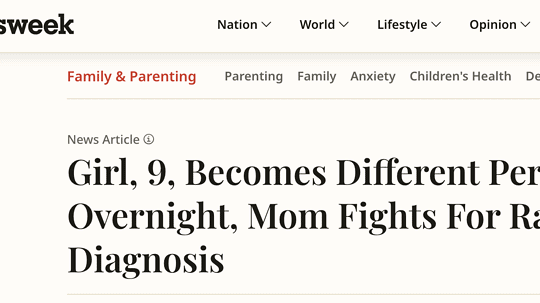
Strep throat is a common childhood illness, but in a few children this bacteria infection can lead to alarming, lasting changes in behaviour. Scientists are now starting to unravel how it affects the brain.
Strep throat is a common childhood illness, but in a few children this bacteria infection can lead to alarming, lasting changes in behaviour. Scientists are now starting to unravel how it affects the...
Joint Rebutttal Statement to the AAP
Joint Rebuttal to the American Academy of Pediatrics Clinical Report on PANS (12/16/24)...
Nebraska PANS PANDAS Awareness
🌿 In May, during Mental Health Awareness Month, our Nebraska State Leads—Grace Troupe and Elizabeth Fandl—joined Where There’s a Will Foundation for their annual mental health awareness walk...
Serum zonulin level in autistic children and its relation to severity of symptoms a case-control study
Sonbol, H.M., Abdelmawgoud, A.S., El-kady, N.M. et al. Serum zonulin level in autistic children and its relation to severity of symptoms a case-control study. Sci Rep 15, 27802 (2025). https://doi.org/10.1038/s41598-025-11420-0
- Findings: Children with autism had significantly higher serum zonulin levels (avg. 73 ng/ml) vs. neurotypical controls (avg. 22 ng/ml).
- Correlation: Higher zonulin levels were strongly associated with greater symptom severity (r = 0.9).
- Mechanism: Zonulin regulates tight junctions in the intestinal and blood–brain barriers; elevated levels increase permeability (“leaky gut”), promoting systemic and neuroinflammation.
- Relevance to PANS/PANDAS: Similar barrier dysfunction and inflammation may contribute to symptom flares following infections or immune triggers.
Virginia PANS PANDAS Updates
Virginia PANS PANDAS Updates Virginia Alliance for PANS/PANDAS Action (VA4PA) is leading legislative efforts. Please contact them directly for more information. Their website is VA4PA and...
Epigenetic, ribosomal, and immune dysregulation in paediatric acute-onset neuropsychiatric syndrome
Han VX, Alshammery S, Keating BA, Gloss BS, Hofer MJ, Graham ME, Aryamanesh N, Marshall LL, Yuan S, Maple-Brown E, Yan J, Bandodkar S, Kothur K, Nishida H, Jones H, Tsang E, Lau X, Dissanayake R, Perkes I, Mohammad SS, Brilot F, Gold W, Patel S, Dale RC, et al. Epigenetic, ribosomal, and immune dysregulation in paediatric acute-onset neuropsychiatric syndrome. Molecular Psychiatry. 2025;30:5389–5404. doi:10.1038/s41380-025-03127-5
-
Compared children with PANS and other neurodevelopmental disorders to neurotypical controls; PANS/non-PANS groups reported more early childhood infections and loss of previously acquired developmental skills than controls.
-
Found routine immune testing largely normal, but RNA sequencing showed upregulated ribosomal biogenesis/RNA methyltransferase pathways and downregulated mitochondrial, signaling, endocytosis, and immune pathways.
-
Toll-like receptor stimulation showed reduced TNF and IL-6 responses in PANS; post-IVIG RNA sequencing demonstrated partial normalization of dysregulated pathways.
-
Authors conclude findings support immune and epigenetic dysregulation in PANS and provide rationale for immune-modulating therapies.
Pediatric acute neuropsychiatric syndrome (PANS) and Pediatric Autoimmune Neuropsychiatric Disorders associated with Streptococcal Infections (PANDAS) in the Context of EMTICS: Methodological Considerations and Misinterpretations
Turowski, P., Fetz, K., Chang, K. et al. Pediatric acute neuropsychiatric syndrome (PANS) and Pediatric Autoimmune Neuropsychiatric Disorders associated with Streptococcal Infections (PANDAS) in the Context of EMTICS: Methodological Considerations and Misinterpretations. Eur Child Adolesc Psychiatry 34, 3685–3688 (2025). https://doi.org/10.1007/s00787-025-02747-0
“With the identification of biological markers, distinctions between syndromes like PANS and PANDAS may become clinically obsolete, shifting focus to underlying mechanisms rather than clinical presentation.” The authors argue that current labels like PANS and PANDAS are largely symptom-based frameworks that exist because we lack definitive biological tests. As research identifies reliable biomarkers such as immune signatures, autoantibodies, or inflammatory pathways, these distinctions may become less clinically relevant. Instead of categorizing patients by how symptoms present or which trigger is suspected, diagnosis and treatment could shift toward the underlying biological mechanisms driving illness, allowing for more precise, mechanism-based care rather than reliance on descriptive clinical syndromes.
- EMTICS (European Multicentre Tics in Children Studies) is a large longitudinal study designed to examine environmental risk factors for tic disorders, not to diagnose or test PANS or PANDAS which was not designed, powered, or structured to evaluate PANS/PANDAS, so using it to dismiss these conditions is methodologically incorrect.
- EMTICS did not systematically assess PANS/PANDAS clinical criteria or timing of infections relative to symptom changes.
Mother desperate after insurance denies son’s treatment for coverage with serious brain disease
It’s one of the more common illnesses: strep throat. According to the Centers for Disease Control, strep throat is now at a 20-year high. It is a bacterial infection in your throat and tonsils,...
New York/Connecticut ChitChat Meet Up
In-Person - Danbury, CT - Thursday, June 12 - 10:00am-12:00pm...
REM sleep atonia in patients with pediatric acute-onset neuropsychiatric syndrome: implications for pathophysiology
- Sleep disturbance occurs in up to 80% of children with PANS.
- Study compared 69 PANS patients to 44 age- and sex-matched controls using polysomnography.
- REM atonia index (RAI) was significantly lower in PANS patients.
- 25 of 57 PANS patients had abnormally low RAI vs 1 of 43 controls.
- Normal age-related increase in REM atonia seen in controls was absent in PANS.
- Takeaway: Reduced REM atonia in PANS suggests brainstem dysfunction affecting REM sleep