
February 20, 2019
Infection, Inflammation, and Mental Health: Mapping the Connections.
Pediatric Grand Rounds February 20, 2019 Jennifer Frankovich, MD at Dartmouth-Hitchcock...
Pediatric Grand Rounds February 20, 2019 Jennifer Frankovich, MD at Dartmouth-Hitchcock...

In rare cases, a strep infection can cause kids to experience extreme OCD behaviours, a condition called PANDAS. Many doctors don't know it exists. Two years ago, Craig and Erica Mills packed up...
A child is happy and easygoing one day, then literally overnight refuses to eat, sleep alone, or go to school. He or she may have tics, difficulty sleeping and headaches. The sudden, dramatic onset...

In this true story, one mother shares her journey to find healing for her son and her family. She unpacks the terrifying heartache of suddenly losing the son she once knew, the fierce battle that a...
This live webinar will first briefly discuss how to differentiate the PANS presentation from more typical anxiety disorders and OCD. One of the first goals is helping parents find and connect with...

Nancy O'Hara MD, MPH, FAAPM share her expertise on how to diagnose, treat and manage PANDAS and...

A review of PANS and PANDAS with Dr Ingels. An introduction to how gut health influences susceptibility, other reasons for susceptibility and Low Dose Immunotherapy among other non-conventional...
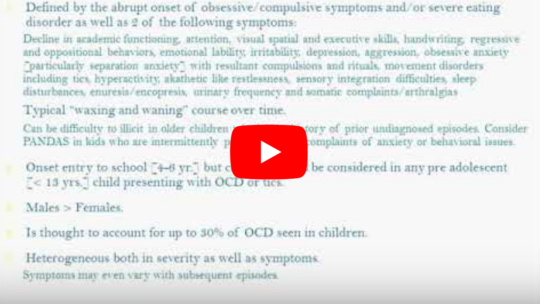
Presented by: Michele Casoli-Reardon, MD, MCPAP North Shore Medical Center Team Medical...

There’s nothing black and white about this mysterious and controversial diagnosis. If your child suffers sudden mental health problems following a case of strep throat, this autoimmune condition...

This video describes the Cunningham Panel of tests and explains the value of and symptoms associated with each of the assays. The role of Dopamine 1, Dopamine 2, Tubulin, Lysoganglioside GM2 and CaM...
This case report describes the effective use of Saccharomyces boulardii in a boy with autism spectrum disorder, obsessive compulsive disorder (OCD), and self-injurious behavior (SIB). Gastrointestinal dysfunction and OCD are frequent comorbidities in autism, which may share a common etiology resulting from a disturbance in normal gut microbiota. Alterations in microbial diversity influence neuroinflammation and are linked to mood disorders, abdominal pain, and SIB. S boulardii is a nonpathogenic probiotic yeast that supports a healthy microbiome, enhances immune function, and reduces diarrhea. Treatment with S boulardii successfully reduced OCD and SIB symptoms in this child.